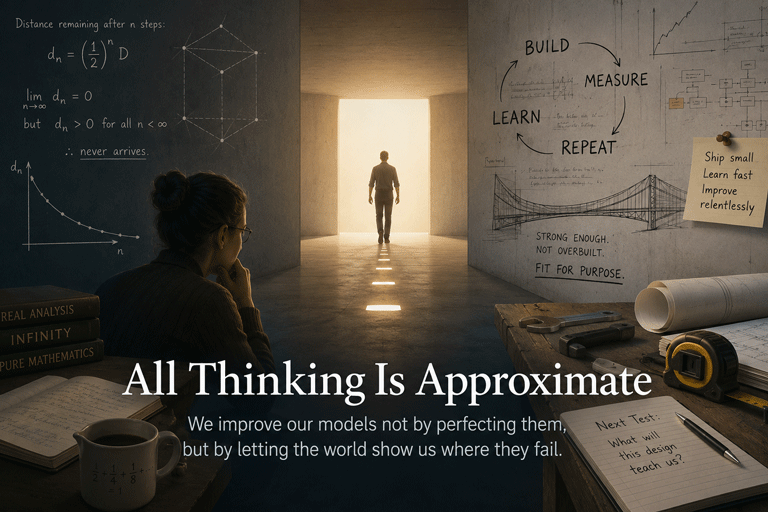
One of my favorite stories involves an engineer and a mathematician, placed at one end of a room with someone they would very much like to meet at the other end. The rule is simple: every thirty seconds, each may walk exactly half the remaining distance. The mathematician smiles, declines, and explains that she will never actually arrive, since whatever distance remains can always be divided in half again. The engineer, hearing the same rule, simply starts walking. The joke depends on both of them being right, and for years I treated it as a comparison between two professional temperaments, the kind of line people trade at conferences and forget by morning. Lately I’ve come to suspect it describes something more general than either profession. It may be describing thinking itself.
That suspicion arrived indirectly, as most useful ones seem to, by way of a question that kept resurfacing in one notebook after another: not how we accumulate facts, but how a mind gradually comes into better correspondence with the world it is trying to understand. The familiar scientific account (formulate a hypothesis, test it, discard the ones that fail) is true enough, and it has served science remarkably well, but it begins partway through the process, after a hypothesis already exists. The stage that interested me more was the one before that, when we are still trying to work out what kind of question we are even asking. That interest sent me into the philosophy of science, where I came across Hans Reichenbach’s distinction between the context of discovery and the context of justification, and once I had that distinction I began noticing its relatives everywhere: Peirce’s abduction, which treats a guess as something to be tested by what happens when you act on it, not something to be admired for its elegance; Tukey’s separation of exploratory from confirmatory analysis, which trusts the hands working the data before it trusts the theory describing it; grounded theory’s insistence that categories emerge from the fieldwork rather than being imposed on it beforehand. I wasn’t finding people who agreed with me so much as people who had each noticed, from a different angle, that an idea earns its standing by being put to use rather than by being thought all the way through in advance.
What stayed with me from that reading is the observation that every explanation we produce is an approximation. A map approximates a landscape. A scientific model approximates a physical process. Language approximates—the word “tree” stands in for an almost incomprehensible diversity of living organisms, each different from every other in ways the word simply ignores. Categories approximate. Analogies approximate. Every explanation is an act of compression, preserving certain relationships while letting countless details disappear, and none of this amounts to failure. It is hard to imagine how a finite mind could work any other way, given that reality contains vastly more detail than we can perceive, remember, or reason about to begin with.
The filtering, in fact, starts before thought does. Vision favors edges and discards wavelengths our eyes were never built to register, not because edges are true and wavelengths are not, but because an organism that can act on edges gets further than one paralyzed by undifferentiated detail. Hearing throws away frequencies outside our range for the same reason. Attention selects a sliver of the sensory information available at any moment, and memory keeps the pattern while letting the details that don’t fit the pattern fade. All of this happens before thought begins, because what a mind needs first is not an accurate world but an actionable one. By the time conscious reasoning starts, the world it is reasoning about has already been reduced to something a mind can carry, and use. Thinking is approximate because perception is approximate, and perception was never really aiming at completeness. It was aiming at traction.
It’s often said that learning means replacing wrong ideas with correct ones. What I’ve noticed in my own case is a little different—not correction so much as a sequence of increasingly useful guesses, each one earning its replacement not by being thought through more carefully but by being used, strained against an actual situation, and found wanting in some specific and informative way. I was reminded of this rather forcefully while working in Eastern Europe some years ago. Before arriving, I assumed the challenge would be largely linguistic—that if I learned enough Russian, I would have taken a substantial step toward understanding the people I hoped to work with. My picture of the region, in other words, was mostly geographic, and I did not discover how much it left out by studying further. I discovered it by talking, and watching the picture fail to carry the weight of an actual conversation.
The real difficulty was not vocabulary. It was learning to think in terms that the phrase “Eastern Europe” barely gestures at—histories that had diverged centuries earlier but still shaped present-day assumptions, political memories that felt distant to me and immediate to everyone around me, exchanges that seemed to be about economics or technology and turned out to rest on cultural experience I hadn’t yet learned to recognize. I hadn’t simply underestimated the region’s complexity; I had misunderstood the nature of the picture I’d brought with me into it, and no amount of additional reading in a library would have shown me that. What improved over the following months wasn’t a single correct model replacing an incorrect one. It was an accumulation of better pictures, each one produced by acting on the last and learning, from the specific way it strained, what it had failed to include—each making the next conversation a little more legible than it would otherwise have been. I suspect that is closer to how most learning actually proceeds, and it was certainly closer to how mine did: not contemplation refining a picture in private, but action revealing where the picture didn’t match what I was standing in front of.
What I am circling, I think, is something close to a working definition: learning is the progressive refinement of approximations through consequential encounter. The encounter has to be consequential—has to be capable of pushing back—because otherwise nothing distinguishes a model that is wrong from one that simply hasn’t been tested yet. And it’s worth being precise about what “wrong” means here, because I don’t think it means what it first sounds like. A model doesn’t fail by being inaccurate in some abstract sense; plenty of inaccurate models go a whole lifetime without anyone noticing, which is itself worth noticing. It fails when the world refuses to cooperate with it—when a conversation doesn’t go the way it predicted, when a beam won’t hold the load it assumed, when a sentence lands wrong in a room it was never tested in. That refusal is always specific. It happens at a particular point of contact, which is exactly the information a revision needs and a verdict like “I was wrong” never gives you. Engineers had a cruder name for the same idea long before I had a precise one: fail fast. It sounds like advice about speed, but what it’s really arguing for is exposure: get the model in front of something capable of refusing it, quickly and cheaply, before you’re relying on it somewhere a refusal would cost you more than information. My geographic picture of the region was going to be refused eventually no matter what I did. The only real choice I had was whether to let that happen cheaply, in conversation, where the refusal was specific enough to teach me something, or expensively, somewhere it actually mattered.
It is also, I think, why analogies work as well as they do. An analogy never claims that two things are identical—only that they are similar in the ways that matter for the question at hand. A subway map ignores nearly everything about the city sitting above it and faithfully preserves exactly what’s needed to ride the trains. A circuit diagram bears almost no visual resemblance to the device it represents, yet captures the relationships that would otherwise be difficult to reason about directly. Good analogies do the same thing deliberately: they sacrifice detail in order to preserve structure, which may be why I find myself reaching for stories as often as I do, like the engineer and the mathematician, an apprenticeship, an explorer’s map. None of these are proofs. They are tools built to be picked up and carried into a situation they did not originate from, which is the only test that ever really matters for them.
This way of thinking has also reshaped how I listen to the public conversation about artificial intelligence. Most of that conversation circles the question of whether these systems truly understand anything, which is a fair question, but I’m no longer sure it’s the most useful one. The question I find myself asking instead is whether the model a system forms ever encounters the kind of resistance mine did in Eastern Europe; whether it is acted upon, refused in some specific way, and revised because of what that refusal reveals, or whether it simply generates from a fixed approximation each time, however vast, without ever closing the loop that turns experience into a better model. Without, in other words, ever truly failing fast, since nothing it generates this week is exposed to a consequence that would change what it generates next week. I don’t think anyone yet knows the answer with much confidence, including, I suspect, the people building these systems. But I find the question more interesting than the one about understanding, because it’s the question that decides whether what’s happening is intelligence making progress, or intelligence holding very still in a remarkably elaborate way.
That distinction matters more than it might first appear, because none of this is an excuse for carelessness. Some models are sloppy, and some are extraordinarily disciplined, and the discipline has less to do with how complete a model is than with how carefully it has been shaped around what will actually be done with it. Engineers rarely seek a perfect description of reality, since perfect descriptions are unattainable; they seek a model sufficiently faithful to the action it needs to support. A structural engineer does not model the position of every molecule in every beam of a bridge. A pilot does not need a forecast accurate to the movement of every air molecule, only one accurate enough to land the plane. A physician recommending treatment works from an understanding of the body that is necessarily partial and, if the physician has done the work, necessarily sufficient. In each case, the question was if it was adequate for the action it was about to permit, not if it was complete. This is a different standard than truth, and in some ways a more demanding one, because it can only be tested by consequences, never settled by admiration alone.
For many years I have repeated a simple engineering principle often enough that colleagues now tease me about it—form follows function—and I’ve come to suspect our explanations follow the same rule, because an explanation is rarely aimed at the world in general. It is aimed at whatever someone is about to do. A tourist map, an engineering drawing, a child’s picture book, and a geological survey can all describe the same place without any of them being complete or interchangeable with the others, because each is a carefully chosen approximation built for a different action. Once I started looking through this lens I found it difficult to stop seeing it: science progressing not toward a final model but through a sequence of models tested by what they let us do; education advancing by handing a student a model good enough to attempt something, then letting the attempt show where the model needs replacing; conversation succeeding not because two people reach perfect mutual understanding but because their models overlap enough to coordinate some shared action; even disagreement beginning to look less like a contest between truth and error and more like two people who have organized their actions around pictures that preserve different features of the same landscape.
That may be why humility seems so essential to genuine inquiry. If our explanations are approximations, then every explanation that succeeds should also leave us wondering what it has left out. Confidence still has its place—we should trust models that have repeatedly held up under use—but that trust is always earned in retrospect, by what a model allowed us to do, never verified in advance by admiring the model alone. Usefulness should never be confused with completeness. Every map omits something. Every theory highlights certain relationships at the expense of others. Every category simplifies, and every language compresses, and the explanations that age best seem to be the ones that never forgot this about themselves.
The engineer, in the end, reaches the other side of the room—not because the mathematics was wrong, but because the mathematics and the engineering were never answering the same question. One asked whether the remaining distance ever became exactly zero. The other asked when the remaining distance stopped mattering enough to keep him from doing the thing he crossed the room to do, and he found that out the only way it can be found out, which is by covering the distance rather than reasoning about it from the doorway. The mathematician isn’t wrong, exactly, even by the lights of this essay. She’s applying the right standard to the wrong room. Within mathematics, refusing to call something settled until it has been proven is exactly the discipline this essay has been arguing for. A proof is itself a kind of consequential encounter, just one where the resistance comes from logical necessity rather than a wall or a stranger’s patience. Her mistake is exporting that standard into a hallway, where the question was never going to be settled by reasoning and was always going to be settled by walking. And there’s something worth noticing in the fact that her model, applied to the hallway, can never actually fail. She never submits it to anything that could refuse it. That isn’t rigor. It’s the one move available to a model that has been kept permanently out of the room where the world might disagree with it. Refusal is the cost of acting. It is also, I increasingly suspect, the only way of being told something specific enough to use.
Perhaps that’s not a limitation of thought after all. Perhaps approximation is not the price intelligence pays for being finite in a world too rich to be fully represented, but the mechanism by which a finite mind makes any progress in one at all—progress measured not by how completely the world has been captured, but by how quickly its failures are found, and how much further action each new approximation makes possible than the one it replaced.
—
Postscript
Every argument reaches a point where it begins generating better questions than answers, and I suspect this essay has reached that point.
One question that continues to bother me is whether consequential encounter can ever be borrowed. I can certainly inherit someone else’s conclusions, but can I inherit the refusal that produced them? A student may learn the right model from a teacher, yet still discover that knowing the model and trusting it under pressure are different things. Expertise seems to require more than correct descriptions. It requires having one’s own models tested against consequences.
Imagination and simulation make the question more complicated. Both can produce genuine surprise, but only when they remain anchored to encounters that have already been tested elsewhere. A thought experiment derives its authority from physical laws that have survived countless encounters with the world. A simulation derives its authority from models that have already been calibrated against reality. A daydream that merely confirms what I already believed is not an encounter at all.
I don’t yet know exactly where these boundaries lie. For now, that uncertainty feels less like a weakness in the argument than an invitation to continue testing it.
Further Reading
Readers who recognize echoes of other traditions are not imagining them. Many of the ideas explored here have deep roots in philosophy, engineering, psychology, and the philosophy of science. The following works influenced my own thinking, though this essay represents an attempt to synthesize them rather than summarize them.
- Hans Reichenbach, Experience and Prediction
- Charles Sanders Peirce, selected writings on abduction and inquiry
- John W. Tukey, Exploratory Data Analysis
- Donald Schön, The Reflective Practitioner
- Herbert Simon, The Sciences of the Artificial
- Michael Polanyi, Personal Knowledge
- Gregory Bateson, Steps to an Ecology of Mind
- James C. Scott, Seeing Like a State
- Andy Clark, Surfing Uncertainty
- Karl Weick, Sensemaking in Organizations