A Reflection for the AI-Skeptical Writer
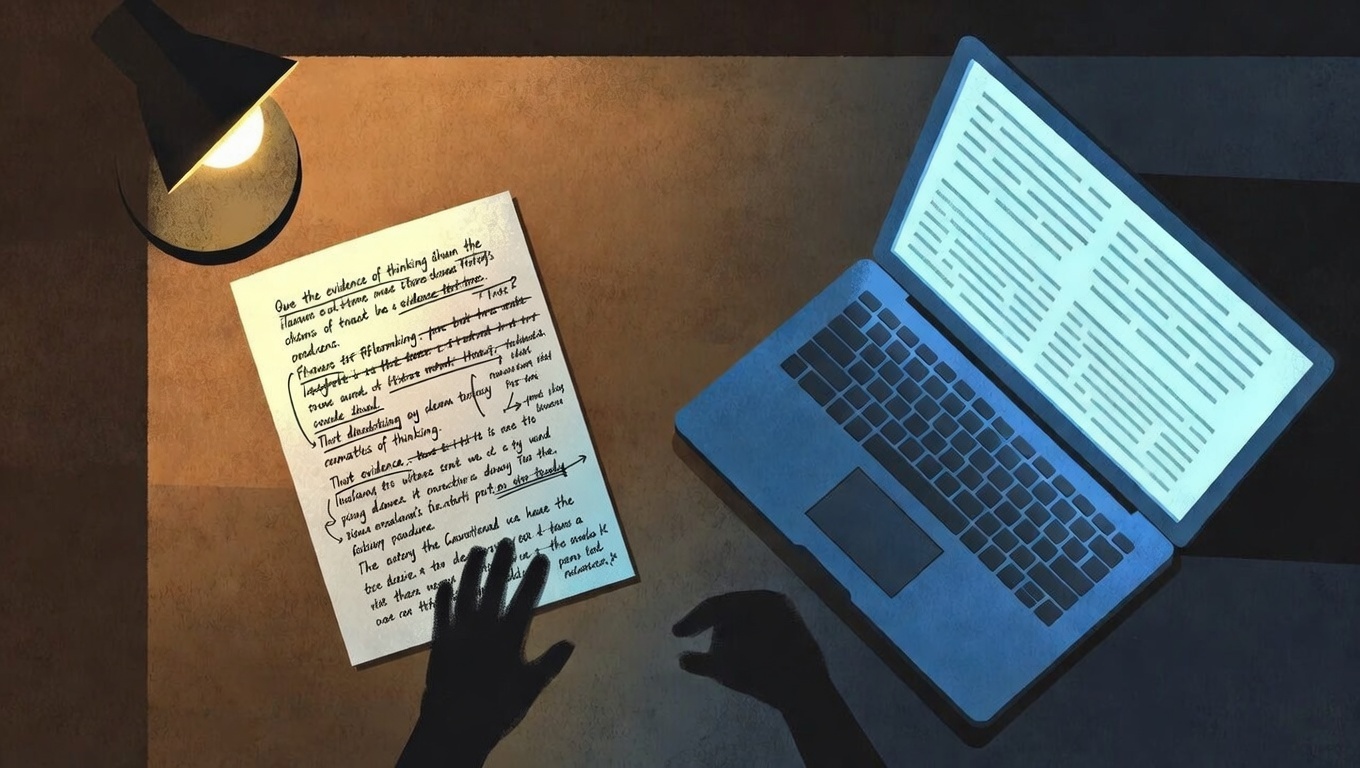
The writers I most respect are the ones saying no. Not loudly, not as a performance of principle, but quietly — drawing a line around the work and what it requires of them. I have heard the reservations echoed in conversations with fellow creators: fears of dilution, of originality eroded, of the human spark dimmed by algorithmic precision. These concerns are not unfounded; they stem from a deep-seated guardianship over the craft that has sustained us through centuries of technological shifts, from quill to typewriter to word processor.
Consider, for a moment, the story of Elias, a poet of middling renown who, in the twilight of his career, encountered this digital companion. Elias had spent decades honing his verse, drawing from the well of personal memory and quiet observation. His poems were not grand epics but intimate reflections — on the weight of words, the irony of final moments, the subtle divergences in human paths. One evening, prompted by curiosity rather than need, he fed a line from his latest draft into an AI tool: “We are going in the same direction, but at different speeds.” The response came instantaneously: a polished extension, complete with metaphors of fading blossoms and whispered promises. It was competent, even elegant in its structure. Yet Elias paused, his hand hovering over the keyboard. Something was absent — not in the words themselves, but in the space around them.
This absence recalls T.S. Eliot’s haunting motif in “The Hollow Men”: the Shadow that falls between the idea and the reality, between the motion and the act. In the context of writing, the Shadow is that liminal void where intention meets execution, where the raw impulse of creation contends with the friction of doubt, revision, and discovery. For skeptics of AI, this Shadow manifests as a profound unease: the machine bridges gaps with statistical certainty, but in doing so, it bypasses the human tremor — the lodged bullet of a critical word, the ordinary sensory flicker in a dying man’s thoughts, the uncertain echo of love yelled across a widening distance. AI outputs arrive fully formed, without the scars of struggle that give poetry its authenticity. They mimic voice without the vulnerability that makes it resonate.
And here is where the skeptic’s instinct deserves more than a passing nod — it deserves to be taken at full weight. The concerns that writers like Elias carry are not mere technophobia dressed in literary clothing. They are ethical, economic, and existential, and they compound upon one another in ways that no single reassurance can dissolve.
Begin with the question of whose words trained the machine. The datasets on which these models are built include the uncredited, uncompensated work of living writers — poems, essays, novels — absorbed without consent and repurposed to generate fluency that can now compete, however hollowly, in the same marketplace. This is not an abstract injury. It is the specific labor of specific people, often people who can least afford to have their work devalued. When Elias felt that something was absent in the AI’s extension of his line, he was responding to more than aesthetics; he was sensing the presence of a borrowed familiarity — a voice that had learned from voices without acknowledging them.
The economic dimension compounds this wound. Publishing platforms already strained by digital saturation now face a flood of generated content that can be produced at negligible cost and algorithmic scale. The labor of the human poet — the weeks spent on a single stanza, the years of apprenticeship that precede a mature style — finds itself priced against an output that took milliseconds. The market does not always distinguish between the two, and when it does not, it is the human who loses ground. Elias had spent a career building an audience for work that was unmistakably his own; he understood intuitively that what AI mimicry threatens is not just revenue but the entire ecology in which original voices are cultivated and heard.
Then there is the question of what is lost in the learner. Elias remembered his own years of struggle — the failed drafts that taught him more than the successful ones, the resistance of language that forced him to find something truer than his first impulse. For younger writers, the temptation to shortcut this developmental grind is real, and the consequences are not immediately visible. A poem generated from a prompt may satisfy an assignment; it will not build the interior resources that twenty years of struggle would. Educators sense this, and their anxiety is well-founded. The very friction that AI removes is often the substance of the education.
Beneath all of these specifics lies a philosophical rift that may be the hardest to bridge. If writing is an extension of the self — a means by which the writer comes to know what they think, feel, and believe — then delegating even a fragment of that process to a non-sentient system is not merely a shortcut. It is a substitution of one kind of knowing for another, and what is lost in the substitution may not be recoverable. This is not a sentimental argument. It is a claim about the epistemology of creative work: that the struggle to find the right word is inseparable from the struggle to find the right thought, and that an entity incapable of thought cannot genuinely assist with either.
Elias understood this implicitly. The generated extension of his line had not helped him think; it had offered him the appearance of thought without its substance. He sat with that for a long time before he did anything at all.
Yet, in the spirit of measured speculation, we might pause to examine the other side of this divide. Among my favorite writers is Isaac Asimov, who spent his career imagining futures in which technology amplified rather than supplanted humanity — futures complicated by genuine ethical tension, but navigated by characters who chose engagement over abstention. Asimov’s robots were not villains; they were mirrors in which human beings were compelled to examine their own values. The stories worked because he refused to let either side off the hook. The technology was real, the stakes were real, and the only way through was to think harder, not to look away.
AI, for all its limitations, is not an autonomous force bent on replacement; it is a tool, shaped by human hands, and capable of being wielded with discernment. It is also capable of being badly wielded, or wielded in bad faith — which is precisely why the writers most skeptical of it are the ones whose engagement matters most. When Elias finally returned to his poem, he found himself pushing back against the generated version with a clarity he hadn’t possessed before he saw it. He discarded most of what the machine had produced, but retained a single phrase — not because it was good, but because it was wrong in an illuminating way, the way a student’s misreading can sometimes reveal what a poem has left unsaid. He revised from that friction rather than from the machine’s fluency. The poem that emerged was entirely his own. But the confrontation had sharpened it.
This is not an argument for adoption, and it is certainly not a dismissal of the reservations that writers like Elias carry with them through every encounter with these tools. The terrain is shifting faster than most of us expected, and opting out entirely carries its own costs — not to the individual writer’s conscience, which is a legitimate thing to protect, but to the collective conversation about how these tools are built and governed. Publishing platforms employ algorithms to curate content; search engines surface AI-summarized results; the discovery systems on which poets depend to reach readers are quietly being restructured by the same logic. To disengage entirely can sometimes mean ceding influence over how those systems evolve, or how they are used to amplify or drown out human voices. Writers who approach AI with critical eyes — testing its boundaries, exposing its hollows — stand to shape what comes next. By participating in dialogues, submitting feedback to developers, or experimenting in controlled ways, we can advocate for safeguards: transparent sourcing, fair attribution, features that enhance rather than erode the human element.
None of that requires abandoning the skepticism that protects the work.
Elias did not abandon his. He returned the tool to its drawer after that single session, not in disgust but with a clearer sense of what he was protecting and why. His poems retained their grounded intimacy — the weight of words, the irony of final moments. But he had seen the Shadow more plainly than before: not only the one that falls between the idea and the reality, but the one that falls between a voice and its imitation. He knew, now, which side of that divide he was on.
For those who share his caution, the path forward need not be resolved tonight. It might begin only with a willingness to look — to understand the terrain well enough to know what is worth defending, and to defend it with the same rigor we bring to a difficult line. The page asks that of us. So does the moment.
Postscript: What the Machine Produced
The line Elias fed into the tool was this: We are going in the same direction, but at different speeds. For the curious reader, here is what came back.
We are going in the same direction, but at different speeds.
You, with the weight of years in your pockets,
each stone a word you chose not to say —
I, with nothing to carry, moving
the way light moves through an empty room.
The blossoms do not wait for us.
They fall at their own pace, indifferent
to the distance widening between us,
to the promises we whispered into seasons
that have already turned.
Perhaps this is enough —
to walk the same road, to share
the same fading light,
even as your footsteps slow
and mine do not.
You can see what it does. The images are earned from the line itself, drawing from weight, speed, distance, and seasons, but assembled rather than discovered. The “stones as words you chose not to say” is the kind of metaphor that sounds resonant on first reading but empty of meaning on the second. “Indifferent blossoms” and “fading light” arrive on schedule. The emotional arc, a gentle elegy for diverging paths, is the most probable arc, which is precisely the problem. Nothing in it could have come only from Elias. It could have come from anyone who fed the machine that line.
That is the phrase Elias would have sat with before closing the window.