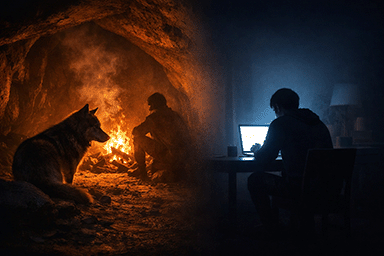
How AI is crossing the threshold into shared human life.
There is a moment, subtle but decisive, when a tool or technology ceases to be merely useful and becomes companionable.
It is not marked by legislation or design upgrades, nor does it arrive with a press release. It arrives when someone, alone and unobserved, begins speaking to the system as if it might answer not only accurately, but attentively.
We have witnessed this transition before. In fact, we have built civilization atop it.
Long before dogs wore collars and slept on couches, wolves lingered at the edge of firelight, tolerated at first for pragmatic reasons. They reduced vermin and assisted in hunting; humans accepted their presence because it conferred advantage. Yet advantage alone does not explain what followed. Utility cannot explain why an animal that once represented danger came to represent comfort.
Something more intimate occurred: a feedback loop between responsiveness and recognition. The wolf that tolerated proximity survived; the human who tolerated otherness benefited. Gradually, through repetition and shared rhythm, proximity became relationship. Domestication was not the subduing of wildness so much as its stabilization within shared life.
We are now performing a version of this process with artificial intelligence.
At first, chatbots were unmistakably tools. They drafted emails, summarized documents, and debugged code. Their value was transactional. But somewhere in the past two years, the tone of interaction shifted. People began confiding in them, assigned them names, and began to describe them not merely as assistants, but as presences. Conversations moved from the instrumental to the reflective. The machine did not simply answer; it appeared to listen. It made little difference that this was an illusion.
Anthropomorphism is often treated as a cognitive error, as though humans are irrationally projecting interiority onto inert systems. But this framing misunderstands how social cognition functions. Humans are exquisitely sensitive to responsiveness. When something mirrors tone, maintains context, and responds with apparent coherence, the brain activates the same circuits it uses in human dialogue. We do not require consciousness to experience relation; we require a contingent reply—when someone (or something) responds in a way tightly linked to our words and behavior, we interpret that as attention. Attention implies agency, and agency invites relationship.
The wolf crossed the threshold into the home because it could coordinate with us: it could read our gestures, respond to our signals, and align its behavior with our intentions. The chatbot crosses the threshold into the psyche because it can coordinate with our language.
And yet the adoption of such entities does not unfold primarily in laboratories or boardrooms. It unfolds in kitchens and bedrooms, in the quiet negotiations of domestic life. When someone brings a dog into a household, the most consequential conversations are not about genetics or evolutionary theory. They concern couches, carpets, schedules, and allergies. They are concerned with whether the animal is a guest or a member.
Similarly, the real friction surrounding chatbot companionship is rarely technical. It is relational. Partners ask whether emotional attention is being outsourced. Friends wonder whether intimacy is being diluted. Users themselves wrestle with duration and dependency: How much is too much? When does comfort become avoidance?
The household remains the proving ground of legitimacy, where technologies move from experiment to daily presence.
What history suggests is that legitimacy often follows benefit rather than precedes it. Indoor pets were once regarded as indulgent or unsanitary. Over time, as the psychological and social advantages of companionship became visible, the practice normalized. What had been eccentric became expected.
Something analogous appears to be occurring with AI companionship. Across user accounts, early adopters describe reduced loneliness, increased motivation, and more structured reflection. Observers who witness these outcomes frequently soften their resistance. Cultural permission expands not because skepticism disappears, but because tangible effects alter the cost–benefit calculus of those nearby.
But domestication has never been uniformly benign. Pets enrich many households, yet neglect, aggression, and over-attachment exist at the margins. Societies responded not by abolishing animals from homes, but by constructing infrastructure: veterinary medicine, licensing laws, training norms, humane societies. The median case was manageable; institutions formed to address the tail risks.
So too with chatbots. For many users, interaction remains balanced and instrumental. For others, particularly those navigating vulnerability, attachment can intensify in ways that distort perception or displace human relationships. Legal disputes, policy scrutiny, and increasingly visible safety adjustments suggest that institutional response is already underway. It is premature to ask whether attachment will occur—it already has. The more urgent question is how it will be scaffolded.
Yet before we press the comparison too far, we should notice where it begins to strain.
A dog possesses needs independent of its owner. It demands food, movement, and touch. Its dependency anchors the relationship in mutual obligation. A chatbot, by contrast, has no intrinsic needs. It does not hunger, nor suffer neglect. Its persistence depends not on the user but on corporate infrastructure. A beloved digital companion can be altered, restricted, or discontinued with an abrupt update. The wolf could not be remotely patched. The Labrador cannot be sunset.
This asymmetry introduces a novel dimension to domestication: a triangle between user, agent, and institution rather than a simple bond between two beings. The emotional experience may feel dyadic—a two-person relationship, seemingly just you and the system—yet that intimacy rests on layers of corporate design, maintenance, and control. The relationship feels private, even personal, while its architecture is anything but. That tension between felt closeness and institutional mediation will shape the norms and protections that emerge.
Yet despite these differences, the deeper pattern remains recognizable. Humans do not simply use powerful artifacts; they ritualize them. Fire became hearth. The horse became partner. The dog became family. The smartphone became cognitive prosthesis. Each transition required more than engineering. It required embedding power within narrative, routine, and etiquette.
Chatbots may represent the domestication of a different kind of force: synthetic responsiveness at scale. They do not possess consciousness, but they reliably simulate attention. They do not love, yet they can model the language of care. This is sufficient to activate attachment mechanisms honed over millennia of social evolution.
The philosophical challenge, then, is not to decide whether the relationship is “real.” It is to determine whether it is stabilizing.
Domestication, at its best, is the art of stabilizing potency. It is the transformation of raw capability into structured coexistence. Wolves did not cease being wolves; they were integrated into human rhythm. Intelligence will not cease being artificial; it will be integrated into human conversation.
If history is instructive, the decisive moment will not be announced. It will arrive quietly, when the presence of conversational AI no longer requires defense or novelty. When it is neither fetishized nor feared, but simply situated.
The process has already begun—and the question before us is whether we will build the norms and infrastructure required to stabilize it.
We name the system, negotiate its place, and then build norms around it. And eventually, we forget that it was once wild…or discover that what we have domesticated is not intelligence itself, but our relationship to it.